ASML
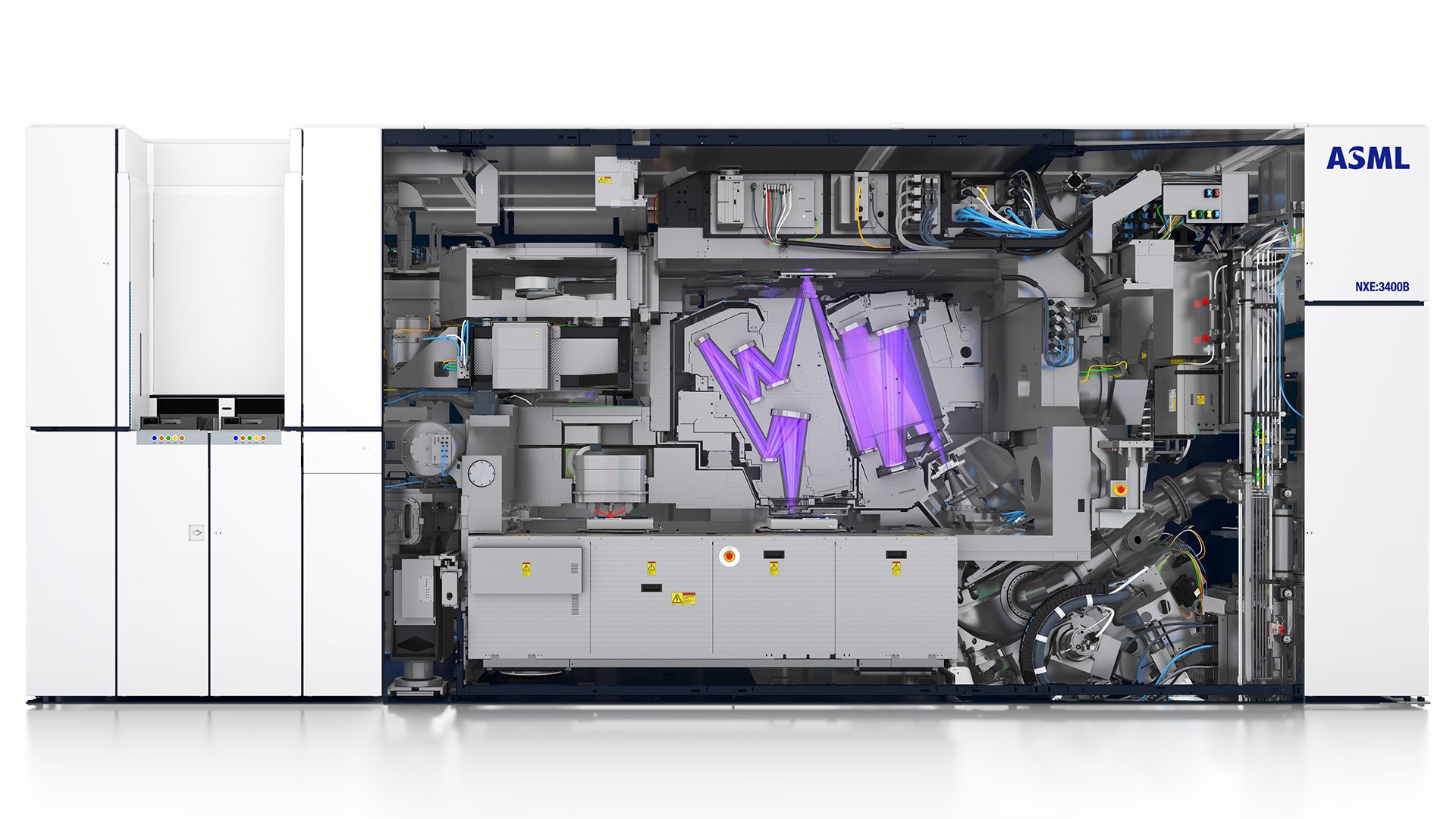
TWINSCAN NXE:3800E
Provisional entry — research in progress
This page was generated automatically from cited public sources and hasn't completed the full research pass yet. Every specification shown carries its source; more detail is added as research completes.
Node / era
2 nm Logic nodes and leading-edge DRAM nodes
Optics
13.5 nm EUV[1]
Where it fits in the process flow
The TWINSCAN NXE:3800E is used in the lithography step of semiconductor fabrication, where it prints the most intricate layers of a chip. Chipmakers use NXE systems to print the highly complex foundation layers of their 7 nm, 5 nm, and 3 nm nodes, with this model extending to 2 nm Logic and leading-edge DRAM. After EUV exposure, wafers proceed to subsequent process steps such as etching, deposition, and ion implantation to complete the integrated circuit structure. The system operates in parallel with DUV lithography systems, which print the remaining layers of the chip.[1]
What can it run?
Process applications and technology nodes documented for this tool.
- High-volume manufacturing of advanced Logic and Memory chips
What do the numbers mean?
Optics & imaging1
Configuration & options2
What replaced it?
Related models
- siblingASML TWINSCAN NXE:3600D— Also part of the NXE series, supports 2 nm Logic nodes and leading-edge DRAM nodessource[1]
- siblingASML TWINSCAN EXE:5000— NXE systems use 0.33 NA EUV for 13 nm resolution; EXE is next-generation High NA.source[1]
Where are the manuals?
Generated from public-source data on file. Enter your email to access — nothing is published; details are routed privately.
Not publicly documented
Field notes
No research found yet — worked with this tool? Share what you know.
Frequently asked questions
What is the TWINSCAN NXE:3800E?
The TWINSCAN NXE:3800E is a dual-stage EUV lithography system that supports high-volume manufacturing of 2 nm Logic nodes and leading-edge DRAM nodes.[1]
What wavelength of light does the TWINSCAN NXE:3800E use?
The TWINSCAN NXE:3800E uses extreme ultraviolet light with a wavelength of 13.5 nm.[1]
What numerical aperture does the TWINSCAN NXE:3800E have?
The TWINSCAN NXE:3800E has a numerical aperture (NA) of 0.33.[1]
What resolution can the TWINSCAN NXE:3800E achieve?
The TWINSCAN NXE:3800E prints microchip features with a resolution of 13 nm.[1]
How does the TWINSCAN NXE:3800E generate EUV light?
The TWINSCAN NXE:3800E generates EUV light by firing a CO2 laser at fast-moving tin droplets, vaporizing them to create the light.[1]
Not publicly documented
The following facts about the TWINSCAN NXE:3800E are absent from this record as of this revision. First-hand knowledge or a citation closes a gap; every submission is reviewed before publication.
No publicly documented production dates or lifecycle milestones (introduction, end of production, EOL) for the TWINSCAN NXE:3800E are on record.
Answerable by: OEM historical records or a trade-press announcement
No publicly documented variants, configuration options, or revision breakpoints of the TWINSCAN NXE:3800E are on record.
Answerable by: an OEM product catalog or an engineer who ordered or specified the tool
The control-system platform and OS era of the TWINSCAN NXE:3800E are not on record.
Answerable by: an engineer who operated it or OEM installation records
No publicly documented failure modes or field errata for the TWINSCAN NXE:3800E are on record.
Answerable by: a field service engineer, process engineer, or maintenance technician
No publicly documented compatible parts, consumables, or accessories for the TWINSCAN NXE:3800E are on record.
Answerable by: an OEM parts catalog or a service engineer
No research found yet — worked with this tool? Share what you know.
Sources & citations
Sources (1)Every fact above is drawn from these public sources
- [1]asml.com — asml.comasml.com
Last updated Sep 22, 2026.
Compare with similar tools
View all →Brooks 017-0146-01 is a prealigner manufactured by Brooks.
The EVG 101 is an advanced resist processing system for spin or spray coating and developing of wafers up to 300 mm.
