MRSI
M3
Provisional entry — research in progress
This page was generated automatically from cited public sources and hasn't completed the full research pass yet. Every specification shown carries its source; more detail is added as research completes.
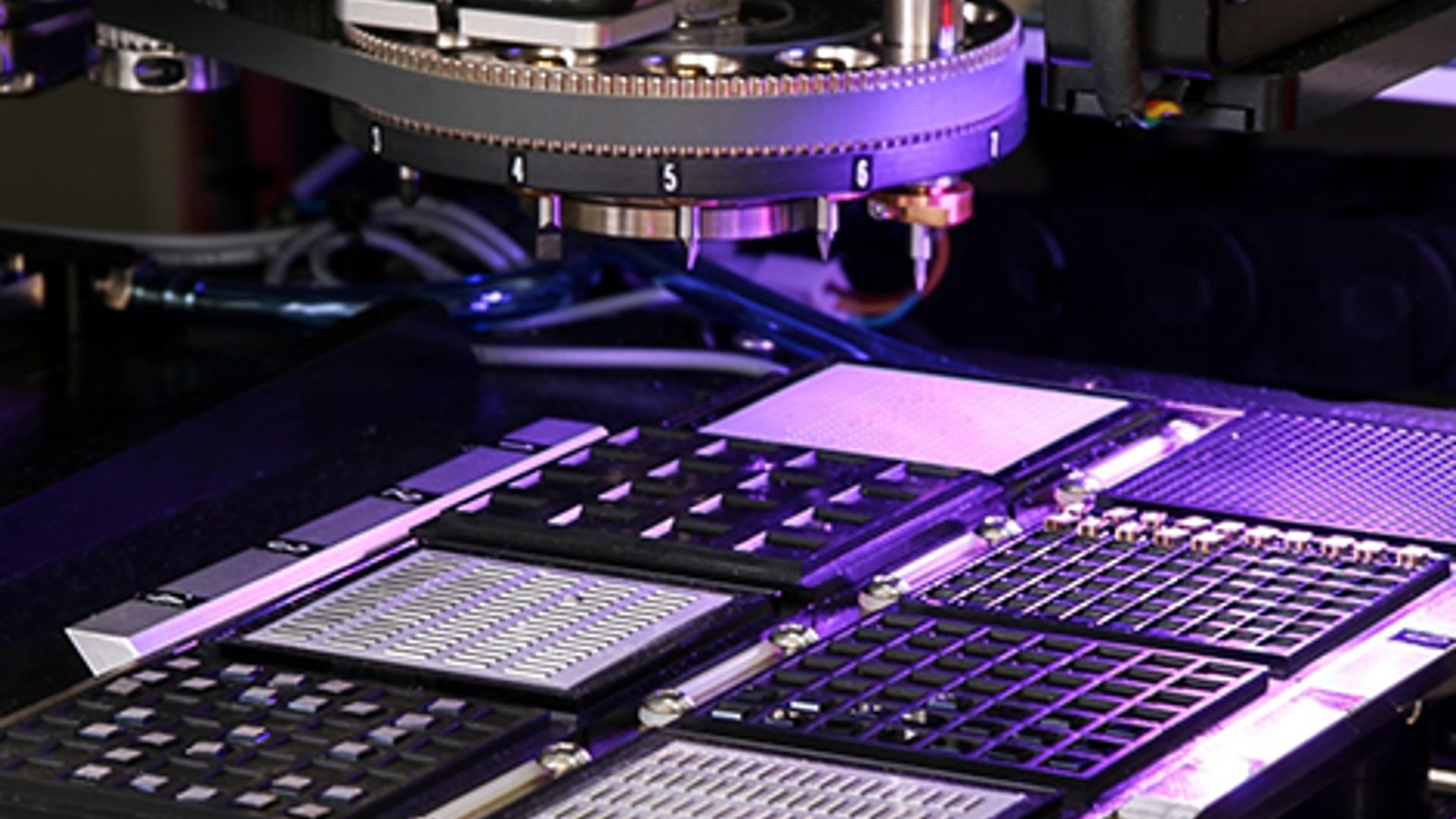
The MRSI-M3 is an ultra flexible 3 micron flip-chip die bonder used for research and development prototyping to low/medium volume production. The MRSI-M3 is a 3 Micron Flip-chip Die Bonder from MRSI Systems.[1][2]
What it is
The MRSI M3 is a die bonder in the MRSI die-bonding equipment family. The M3 is a 3 micron flip-chip die bonder used for research and development prototyping and for low to medium volume work.[2]
How it works
The MRSI die-bonding product family offers multiple process options. The family includes die bonding, eutectic die bonding, and epoxy die bonding.[2]
Applications
The MRSI M3 is used for research and development prototyping and for low to medium volume production.[2]
The MRSI die-bonding family serves photonics, AOC, high power laser diodes, optical components and transceivers, silicon photonics, TO-TOSA and ROSA, microwave and RF, RF power amplifier and microwave device, microelectronics, sensors, LIDAR, AR, VR, MR, and wafer level packaging applications.[2]
What do the numbers mean?
Performance2
Configuration & options2
Vintage & configurations
Documented models & variants
| Designation | Generation | Vintage | Changes | Source |
|---|---|---|---|---|
| MRSI-M3 with Turret | — | — | Turret configuration | web.archive.org[3] |
Where are the manuals?
Generated from public-source data on file. Enter your email to access — nothing is published; details are routed privately.
Not publicly documented
Field notes
No research found yet — worked with this tool? Share what you know.
Frequently asked questions
What class of machine is the MRSI M3?
The MRSI M3 is a 3 micron flip-chip die bonder.[2]
What production range is the MRSI M3 intended for?
The MRSI M3 is intended for research and development prototyping and low to medium volume use.[2]
What broader MRSI product family includes the MRSI M3?
The MRSI M3 is part of the MRSI die-bonding product family.[2]
Not publicly documented
The following facts about the M3 are absent from this record as of this revision. First-hand knowledge or a citation closes a gap; every submission is reviewed before publication.
No publicly documented production dates or lifecycle milestones (introduction, end of production, EOL) for the M3 are on record.
Answerable by: OEM historical records or a trade-press announcement
The control-system platform and OS era of the M3 are not on record.
Answerable by: an engineer who operated it or OEM installation records
No publicly documented failure modes or field errata for the M3 are on record.
Answerable by: a field service engineer, process engineer, or maintenance technician
The process node or technology generation of the M3 is not on record.
Answerable by: an OEM datasheet or a fab qualification report
No publicly documented compatible parts, consumables, or accessories for the M3 are on record.
Answerable by: an OEM parts catalog or a service engineer
No research found yet — worked with this tool? Share what you know.
Sources & citations
Sources (4)Every fact above is drawn from these public sources
- [1]MRSI-HVM1, 1-Micron Die Bonder for High Volume Manufacturing — web.archive.orgweb.archive.org
- [2]mycronic.com — mycronic.commycronic.com
- [3]web.archive.org — web.archive.orgweb.archive.org
- [4]Visit MRSI at the Compound Semiconductor Advanced Technology & Application Conference - MRSI Systems — web.archive.orgweb.archive.org
Last updated Oct 11, 2026.
Compare with similar tools
View all →
Applied Materials model 0010-47763 is an ASSY ESC Bonded Monopolar Dual Heated unit.
The Applied Materials 0041-26723 is a bonded assembly used in semiconductor packaging and bonding applications.
The Logitech 1 WBS 1 is a wafer substrate bonder for 6-inch wafers.

